Will Self at Battersea Power Station
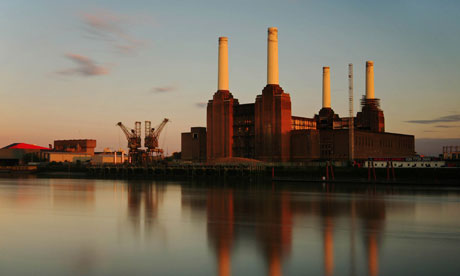
Even with the new logo buildings – the Shard, the Gherkin, the Quill et al – spearing London’s lowering skies, Battersea remains unrivalled when it comes to that most banalised form of contemporary status: the ‘iconic’. Certainly Battersea’s iconic status was uppermost in Tincknell’s mind as he led me, together with his head of communications, Alison Dykes, through freshly landscaped grounds – hardwood decking, raised flowerbeds, gravel pathways – towards the sales suite, pointing out on the way a scale model of the power station about the size of the average family home. ‘Isn’t it fantastic,’ he enthused, ‘it’s the one they used for the Olympics’ closing ceremony, one of only seven iconic buildings that Danny Boyle chose.’
Inside the suite I took my squishy seat at an opulent lozenge of a table, Alison settled herself a few places off, Tincknell launched straight into his PowerPoint spiel – just as if I were some important oligarch or Chinese millionaire intent on investing. He told me his previous developments included such exercises in ‘place making’ as Portsmouth’s Gunwharf Quays, which gave me pause for thought, because the Quays is a completely generic example of the glass’n’steel mixed retail/residential/ commercial development, distinguishable only by the ghastly Spinnaker Tower, a signature eyesore of bellying white spars that makes Anish Kapoor’s absurd Olympics evisceration, the ArcelorMittal Orbit, look positively subtle. Oh well, no matter, because unlike the poor blitzed Pompey docks, or Stratford marshes, the power station has oodles of authenticity to spare.
Or, as Tincknell put it: ‘Battersea has iconic authenticity, industrial heritage oozes from every brick.’ He went on to explain that the power station presented an ‘iconic image on London’s skyline’, and that this was why ‘iconic brands’ – such as Red Bull, the Batman movie franchise and, gulp, the Conservative Party (Cameron launched his 2010 election manifesto in its brick gulch) – chose to be associated with it.
I suppose I should have let Tincknell rattle on like this – he seemed happy enough. But the problem is that Battersea power station and I have form: I live less than a mile away, and its upside-down table leg chimneys have dominated my immediate skyline for almost twenty years: I clock them when I walk the dog in the local park, or if I go to the post office on the Wandsworth Road. On my way into town over Vauxhall Bridge I see them looming over the Thames littoral, while when I cycle home, late at night, across Chelsea Bridge, the sight of a late train emerging from the silhouette of the power station to head over the railway bridge towards Victoria always summons De Chirico’s canvases to my mind’s eye: the juxtaposition of colonnades, trains and arbitrary hunks – human musculature or masonry – evokes urban alienation by perspectival overdetermination. Anything fundamental happening to the power station – which has been slowly mouldering away through my entire adult life – will be the architectural equivalent of a ‘domestic’.
But again, to be fair to Tincknell, he’s not the only one who’s convinced of Battersea’s iconic status; he told me that 14,000 people had turned up for the public consultation meeting to consider his development plan – for any less emotive building numbers would have been paltry. Indeed, so many local people felt they had something to contribute that the meeting was held in the power station itself: a nice circularity, as if Battersea had been built solely as a venue for consideration of its own renovation. Still, I probably shouldn’t have chimed up with ‘Iconic of what, exactly, Rob?’ because Tincknell, dropped out of his script, was so flummoxed that after thirty seconds or so I had to rescue him: ‘You mean iconic of Britain’s great industrial past, don’t you?’ A pabulum he seized on, and which allowed him to continue spieling; at one point he got a slide up on the PowerPoint that juxtaposed equally vacuous ascriptions – Authentic/Exclusive, Industrial/Inclusive, Ours/But-It’s-Yours – and then told me that the great thing about the Battersea development would be its dissolution of these vaporous alternatives. The brand (he used the term shamelessly) would be both safe and exciting, both exclusive and – yes – inclusive. Rob is much preoccupied by what makes ‘a great place’, but worryingly – considering he aims to make Battersea an autonomous ‘city centre’ with its own arts scene – he doesn’t think the Barbican qualifies.
His own wish list when it comes to cultural capital seems oddly abbreviated. He told me he’s asked the Theatre 503 Company to consider moving to the renovated power station from their current venue above a pub up the road called the Latchmere, and referred a little gnomically to something that might be done with the Royal College of Art. There was also talk of the Chelsea Fringe Festival, and later, when he was driving me round the site in his big boxy black Range Rover, he showed me the pop-up park he’s had erected in which pride of place is given to the boat in which Ben Fogle rowed the Atlantic. A pub theatre company and a TV adventurer’s rowboat seem more Bilbo Baggins than Bilbao.
I don’t say any of this to be mean to Rob Tincknell; in fact, I liked him from the onset, and liked him still more when we got away from the PowerPoint icons of the iconic power station and began scaling the real thing. There was no gainsaying his enthusiasm for the building, and while his plan to create an internal sixty-metre atrium – so that those inside will look up at the chimneys soaring priapically over their heads – seems either nutty or embarrassing, there’s no disputing that it’s the sort of masonry magniloquence the global rentier elite revel in. Because, saving Rob’s green and tender egalitarian feelings, there’s absolutely no question that the new Battersea is all about catering to these folk – if not in person, then in the persons of those they buy and let to.